Showing posts with label internet. Show all posts

Saturday, 12 February 2011

Search Engines and Information Overload

  Think about this for a second, what is your home-page? What is the first page that opens on your browser? I'm pretty sure it may be Google or another search engine. It may not, but most people reading this will have it set.

Ok, think about this; how do you actually get to a website that isn't in your favourites? You wont memorise the URL, well I hope not, instead you will type into a search engine the name and from there you will gain access.

  With the internet's primary use to share information, we navigate its entirety via search engines (Google, Yahoo!, Ask.com and Bing), but do these give websites a fair share in the availability to be seen by the public?

  Search engines use rankings when you type certain key words into its search bar. The rankings are based on how popular the site is, how accurately matched it is to your query and now, how much they have been paid to be higher in the list that you see making it more likely for it to be clicked on. Once you click 'search' the engine goes through 3 stages:

1) Web Crawling
2) Indexing
3) Searching

(NOTE: This is quite complicated so bare with me..)
  In the Web Crawling stage the engine uses a bit of AI (see my Are We Able To Create AI post for more information), sometimes known as a spider - a designed program that searches through web links, to gather the initial stages of the search. Next is the Indexing stage, here the program organises the web pages in order  matching the words or phrases that was entered in the search box. The words or phrases that are looked through on the sites are call Meta-Tags. These tags are specific or key words set by the site creator allowing search engines to pick them up, an example would be this blog post. This week's topic is on search engines, information, internet etc. these will all be used as tags that will make it easier for it to be noticed. Once that has been done the final Searching stage begins, this is when all of the sites and the result of your search is displayed. Remember this all takes seconds, sometimes less. Here I'll show you, I'll do a search on Google now on the word 'pizza': lets see how long it takes...


...wow, 0.21 seconds! This just proves that search engines are the most helpful tool on the internet, look at all the results I recieved, '197,000,000', I don't even know what that is...I think 197 million? Anyway, that's allot of information right? I would say, more than enough, which is why this blog post is partly named 'Information Overload', its almost like Google is boasting the amount of results it gives - arrogant search engine!

  With this large amount of information, there should be a fair chance that smaller more independent businesses, but there isn't. When I searched 'pizza' the top three pages were:

save image

This is most probably because Dominos and Pizza Hut have paid Google to be a higher rank in it's servers. This is wrong in my opinion because it means that an independent place is stuck on page 10 of the search, the 10th 'O' in Google's interface or number 100, 000 in the list - and let's face it, your not going to sieve through every link to the 10th page.

  There have been experiments done to compare how users interact with the screen (the positioning of the data from web searches), the experiments were conducted by Gord Hotchkiss:
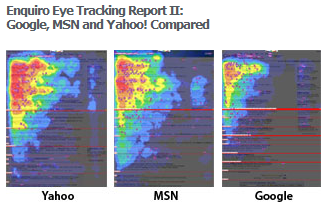
  

Notice the following:


- how tightly Google keeps attention focused on the upper left corner of the search results
- how attention drops off the further down you go on the page
- ads in the right column generally do not get much attention

(www.training.seobook.com/google-ranking-value)
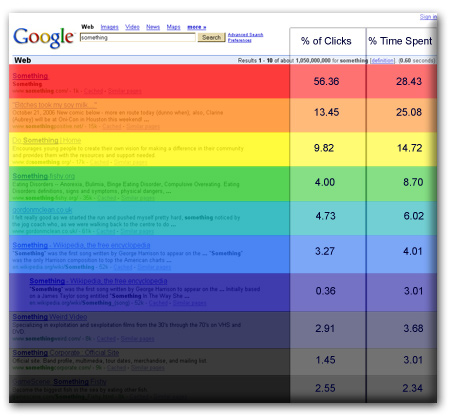

  Notice on this picture, it shows how long each link is looked at along with the amount of clicks it receives. It shows that links at the top (mainly 1-6) are most likely to be seen, as it gets further down the page some aren't even looked at - see the eye test above.

  Staying on the idea about Google rankings, in a post on ramzws.com it talks about how much you spend on getting a website created but then not even making it onto Google. I think this quote, "If you can't find your website in Google then just how much of a bargain was that $495 website?" is a great one to focus on. Because search engines are the encapsulating tool when it comes to browsing the web, if your website doesn't appear then it is almost lost in cyberspace, hardly anyone will come across your site unless they enter in very specific key words. In the blog post on 'ramzws' it says that a site costing $5000 with more pages will probably be seen on search engines more than one with a couple of pages worth $400. I reckon this is wrong, it completely isolates the more independent companies wanting to be seen on the internet although I would agree that it is some what a competitive area, companies battling it out to get to #1 on Google but they must have as much right as the larger companies surely?

Sunday, 14 November 2010

Interfaces - Making using a computer that much easier

So your using a computer and you are looking at the screen and suddenly wonder how you are navigating through the system; well, that my friend is the Interface.

  A UI (User Interface) can be seen everywhere, to you getting money out of a cash machine, calling someone on your new iPhone or Android phone or sending an email on you computer. It is these interfaces on your phones and computers that will be placed under the spotlight today.

  Beginning with a GUI: This interface allows the communication between computer and user via graphical means i.e. Windows 7's icons and windows. The GUI was a revolution in computer history as it allowed everybody access to a computer despite their computer skills which is what was need beforehand i.e MS-DOS was an  early operating system that was used on many personal computers and required text commands to be entered to give the computer commands. These text commands were often long and were not very user friendly to use for example, to copy a file to another location the user could not simply click-and-drag back then they had to type in:

"copy from [source\filename] to [destination\folder]"

Only until upgrade to MS-DOS 5 was a very limited GUI introduced including mouse operation instead of using solely the keyboard. Check out the promo vid of MS-DOS 5.

  Without the help of Ivan Sutherland and Doug Englebart the GUI would not be possible. Ivan invented the Sketchpad which was the first move toward the interfaces we use today. It allowed the user to create shapes on a screen by using a light pen and was a massive leap to how we interact with computers today.

The system still had a size problem to hurdle
The revolutionary user interaction tool
  Doug Englebart was the person responsible for allowing you to move that little mouse around the screen although back then they were massive, imagine dragging a large brick across that lovely new varnished table.


l l
l l
l l
V


  With technology booming in the 21st century new ways of interacting with a computer are always arising whether it being speech or now even movement (i.e. Xbox Kinect, Nintendo Wii or Playstation Move) but here I will be focusing on how websites are viewed and present on GUI's on computers and compare them to GUI's on mobile phones.

Facebook (Computer)


  This site is becoming massively popular and it is now essential to have constant access to this is you are out of the house or office away from your computer.
  On the computer everything looks simple with the 1. logo and the navigation sections along the top of the page and down the left side, tools such as your profile, photos and Fb games are located here. All your friends can be seen here too 2. Down the centre of  the page is your main personalised information appropriately named by Facebook as your 'news feed'. 3. Along the right side of the page is adverts, your events and some information about how to use the site.

Click for full size!!
The website is very easy to use and the same is for its mobile page.

Facebook (Mobile)

  When wanting to use Fb on the move there is either the application of the specifically designed mobile site. The mobile site automatically detects it being accessed by a mobile device and so links it to that format. The mobile site is very easy to use and much like it application sister condensed to the most important information. Although the facebook games cant be accessed from the mobile device that is not much of a problem because while moving around you just want to update you status once in a while.

The mobile site
The app look
   The application as you can see uses a basic GUI to make its use easier. The news feed icon looks like a folded paper and the chat looks like dialogue bubbles.

HMV (Computer)


  This site is very popular for buying games, music, films and electronics; but how does it fair on both a computer and a mobile?
  
Click to view full size
  This site is very visual and hold lots of graphics meaning that its load time is considerably longer than say, Facebook's simple design.
  The design here looks very appealing with the negative space emphasising the main information and the large icons and promo adverts. But on this site there is one element that struggles to cross platform to the mobile world and that is - flash.
  Flash can't be used on any old generation mobile device nor can it on an apple, but recently with Android's firmware update of 2.2 Froyo for its devices flash 10 is supported. But for the majority flash is a large hurdle that cant be overcome easily.

Friday, 29 October 2010

ILOVEBEES: A new way to game?

  With the release of the highly anticipated 2004 Halo 2 game there was something new that had never been tried before. An Alternative Reality Game (ARG) acting as a world wide interactive treasure hunt that was used to promote and advertise the Bungie release.

  For the hunt to begin small hints were needed to be planted for this revolutionary game to proceed. There were two main hints used. Firstly, through the game's trailers. As they were released  something was discovered that left fans and the gaming community baffled. At the end of the advert was a message or indeed a web link, www.ilovebees.com was shown that flashed over Mircrosoft's own resulting in thousands of fans rushing to their computers to divulge into this mysterious website.
  Secondly, a handful of ARG gamers were secretly selected to receive small jars of honey in the post. Suspended within this honey was a letter and all together spelt 'ILOVEBEES'. With the advert and secret honey pots used; the online community flooded with activity in an attempt to understand what this was all about. The ilovebees website seemed a normal site about a person's avid (but strange) love for bees but later looked as if it were under attack from hackers as messages and codes appeared. Again as time progressed the internet forums erupted into cracking these codes and satellite images until collective knowledge revealed that they were coordinates for specific phone boxes around the US.


A phone box sat image 


A woman answers a designated payphone as
crowding fans show the Master Chief Salute

 These phones rang at stated times releasing a certain part of spoken dialogue. Once all the extracts were put together a story into Halo 2's history was created involving all of the loved characters and those who took part were able to join an exclusive screening and online play of the game before its initial release under a condition that they could recite a codeword released over the payphones.
For a video explanation of the ARG: The ILOVEBEES Phenomenon


  This had never been attempted before, an ARG within another game. It re-mediated not only advertising; but gaming as a whole. In terms of advertising, typically the audience is being bombarded on TV, on computers or even now on mobile phones but with ILOVEBEES the audience were actually chasing after the advertiser and because they want to, not like an unknown number beginning with '02...' ringing you up and leaving a message saying that there have been some 'financial issues' with your bank in which you ring up to question this only to find its an advert for another bank that could offer you better interest - this specific example has happened to me! In terms of  re-mediating gaming it changed the way people interacted with games and the idea of games as a whole. Normally with a new game's release the gamer travels to the store to buy the game and then spends the next few weeks chained to the screen in isolation forgetting the key elements of time, sleep and the natural impulse of hunger. An ARG pulls in all players from around the world to communicate and get on one specific goal together which is similar you may think to how Xbox Live or PSN (Playstation Network) works today but it is not. With the online community on consoles it's more about your personal gain, you 'killing' and American kid named 'XboxAddict' gets you 50XP and a new gun or you reaching a specific point gets you this unlocked. In an ARG it uses the same idea of involving countries together and solving a problem i.e. in ILOVEBEES forums were flooded with comments from all around the world that used information from another forum-er, or forum poster? or is it user? I'm not sure what the term is but you get the idea - I hope. This information sparks another idea and so on and so on until the final objective is achieved, in this case: co-ordinates to a phone box or a piece of audio.
   On the other hand you could argue that ARG's are moving away from the idea of what games are. Games allow you to take control of a character, usually much more powerful and capable of completing tasks than yourself, and wander in an alternative world where you can create the rules and control how the game unfolds. In an ARG you are the character and your not in another world fighting monsters and gaining x amount of gold, credits, chips whatever, you're just you.

  This whole ARG idea has re-mediated gaming, changed how we interact with games and has also converged different media types together. Gaming, email, telephones and the internet are all used to portray the game onto the game-field - the world. by providing hints, obstacles and sometimes other players that have to be overcome by the community.

  So there you have it - ARG's. Are they a new way to game? They are growing in popularity as they provide a different perspective on traditional gaming of just sitting in front of a tv and are more communal. But with the release of the Playstation Move and soon Xbox Kinect will it stay or just become lost in its own alternative reality when technology leaves it behind?