Showing posts with label Fun. Show all posts

Saturday, 12 March 2011

Gamers Rewarded Through Faulty Games

  If you have ever played a video game then you will have come across multiple glitches I'm sure, you know the ones, your walking around and suddenly you get stuck on something invisible? Or you can't advance any further over the map because of the 'invisible wall' or 'pipeline'? These are all typical when playing, but can some glitches be used to give the player rewards?

  A glitch is simply a programming error that is hard to troubleshoot because it is not apparent to all players and may not happen all the time. Players can use these errors in the computer code to access areas that may be difficult to get to or to get an unfriendly advantage on other players - these people are know as 'Glitchers'. Although most glitches are unintentionally in the games code the developers may put some in on purpose, these give the players some sort of reward, not to help them advance in the game, but just some sort of 'thanks for playing our game and exploring the boundaries, here is a little prize' sort of thing. These are know as Easter Eggs in the video game community.

  The first evidence of an in-game Easter Egg is in Atari's retro game "Adventure", it it the player's reward for experimenting with the game. To get this egg the player must:

1. Get the bridge 
2. Take it inside the black castle 
3. Find the central room that causes the screen to flicker. You must have an object with you to see the flicker, as it takes 3 game sprites to cause flicker (you, the "dot" and the 3rd object, in this case the bridge) 
4. Use the bridge to get into the secret chamber in the middle of that room 
5. Inside that the secret chamber there is a "dot" -- pick it up by pressing into the lower right corner of the chamber. 
6. Take the dot to the main hallway (below the golden castle) 
7. Once there the dot will cause one of the hallway barriers to disappear. Note that you need to have another object in the room (key, sword, duck, etc.) to make the barrier disappear. You also usually have to have the "dot" in front of you to go through. 
8. You can then enter a hidden chamber that lists a message from the programmers

  The history behind this first Easter Egg is that the creator, Warren Robinette, didn't like the fact that Atari did not allow its programmers to get credit for making the game. In his frustration he altered the code allowing people to discover who the talent really was. The message from the programmers mentioned in point 8 is simply his name:
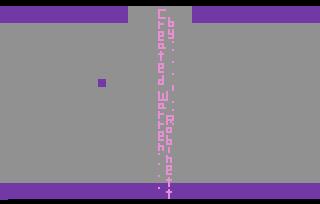
The message: "Created by Warren Robinette"
  Ever since, game developers have been doing the same, rewarding players for simply exploring the boundaries of the game. Some examples are shown below:

In this Easter Egg notice how there is no glitch. This is the case in some games, instead of using a fault in the game the developers just place funny events into hard to reach areas, almost all the time they are funny. It is a surprise to the gamers because they are out of place and often link to other popular games, in this case: Portal developed by Valve.

  This next one is from Halo: Reach on the Xbox 360, check it out:

This sort of Easter Egg is one that provides the most reward sensation in my opinion. It is hard to get to firstly, the switch placed at the very edge of the map and then the spawning into an unknown tunnel. This egg really keeps the player guessing into what is happening.

  One from Assassins Creed 2:


This similar to the Fable 3 one above rewards the player for being curious.

   GTA4:


  I find Easter Eggs a really interesting point to look at because the developers harness glitches and turn them into something entertaining. They can also just put random things into its structure to make it more interesting too. In an interview from VideoJug they ask a game developer a series of questions, one being, "Why do developers put easter eggs in games?"
His answer:

"I think developers put Easter eggs into games just for fun. It's a nod and a wink to the fans; it's a nod and a wink to the players. An Easter egg is usually a little bit cheeky, but it's good fun and they're always meant in good humour."

  So, they are Easter Eggs in video games...

Wednesday, 23 February 2011

Good 'ol Pac-Man: But why is he so fun to play with?

  We play video games because their ultimately a blast to play! There is so much fun in entering a reality other than our own, become another person with often superior qualities to our own. But why are they fun to play?


In this post I will be looking specifically at Pac-Man!
  To make a successful video game it needs some hooks to keep the gamer playing as well as aporias and epiphanies.

  Aporias are certain things programmed into the game to make it challenging, in an essay by Kristine Jørgensen published online she defines it as, 

"a localisable problem in a computer game that must be overcome by some uncertain actions. In this thesis the term implies any problem in a game that the player needs to comprehend and solve by a combination of actions."

These are often paired with the actions that overcome them - called Epiphanies. It is this that creates a sense of accomplishment along with different types of gaming hooks  which will be explained later on.

So, what makes Pac-Man so fun to play?

   Well, if you haven't played it before have a go! 


See, did you have fun? But why?

  One of the first reasons why it is fun to play is the rules, they are simple to understand and make it a game full of excitement:

                  - Pac-Man (you) has to get all the Pills around the board
                  - Power Pills can be used to capture the Ghosts sending them back to the middle of the board
                  - Pac-Man has to avoid the Ghosts 
                  - You move Pac-Man with the arrow keys

  Another reason why the little yellow fella' is fun to play is something called the Magic Circle, this idea was created by a historian Johan Huizinga in his book 'Homo Ludens: A Study of the Play-Element in Culture' in it he lists multiple "play-grounds" where games are played - the Magic Circle as one of them. Huizinga's concept was later applied to Digital Games by Katie Salen and Eric Zimmerman in 'Rules of Play: Game Design Fundamentals', in this they both agree that although Huizinga's term is a single play-ground it is used as shorthand for a fictional and temporary world created when a game begins.


  The players involved within the game are within its Magic Circle, in a board game for example, the Magic Circle here would be the room it was played. In Pac-Man it is slightly different, today you can play Pac-Man on your computer so the Magic Circle is smaller compared to a board game, it is just you and the computer. This kind of circle magnifies the immersion levels considerably because there are no distractions. This kind of game, being a one player hosts Tactical Immersion - where you the player enters 'the zone', you stare at the screen and don't really think about the button presses on the keyboard. 

  Within the circle of a board game you as players agree to an almost invisible contract to how the game plays, but as soon as you leave the room you leave the Magic Circle. In the past Pac-Man was a phenomenon in the arcades. Tonnes of kids would flock to these machines and play and play and play trying to get #1 on the scoreboards. The Magic Circle here is much more social compared to the one on the computer, it is almost like a board game's although it is still a one player game others watching can become immersed. I mentioned the competitive element to Pac-Man, this is another and a large one to why the game is so competitive.

  Both online today and back in the arcades getting the high scores means everything, and because Pac-Man is such a quick game if you loose then you can retry almost instantly - there are no loading screens! This kind of play is a specific gameplay hook. There are specific things within a game that keeps the gamer playing:


- Action Hooks-
  These allow the character to be moved by the player providing interaction between the two, almost like an extension to yourself often with special/signature moves.

-Resource Hooks-
  These provide a resource system in the game i.e. health or ammo. It adds another layer into how the game functions because the player has to go looking for them when they run low. This makes the game, again, more involving.

-Tactical/Strategic Hooks-
   These are typical in RPG's (Role Playing Games) as they allow choice, for example, weapon choice, powers in level growth and discussed in previous posts, every play through of an RGP can be different because of these hooks. Another example is in driving games, the player may choose to draft behind other players to gain a speed advantage. Again, these are not all essential but may provide tactical advantages over other players.

-Time Hooks-
  These kinds of hooks are involving the player with events to come in the future. Waiting to spawn on Call of Duty or waiting for a weapon to appear is another. They allow the player to think ahead  and plan their strategy. A basic time hook is a simple timer, when it reaches zero it is game over. This is such a powerful tool in playing games, especially ones that involve tactical immersion i.e. Pac-Man or Tetris. The player will then try and beat their score and rise the ranks to be the best.

With hooks looked at, the most applicable to Pac-Man are Time Hooks and Action Hooks.

   Mentioned before, Aporia and Epiphanies. In Pac-Man the in-game problems (the aporias) are the pesky ghosts and to an extent, the walls and the actual control mechanics. The controls are unique in that you must press a direction before Pac-Man gets there. This emphasises the tactical side and increases the immersion. Mirrored to this, the epiphany is getting the power pills and capturing the ghosts. Mastering the controls and the navigation through the maze is another. Getting used to the controls in any game is essential but some can be very difficult to grasp. Games like this are fighting games such as Tekken and the newly released Marvel Vs Capcom 3: Fate of Two Worlds. Within these games are very complex moves and combos, these are the aporias but mastering them and pulling them off in an online match are the epiphanies. Click here to see this frantic gameplay in action.

Few! So, there you have it...that is why Pac-Man is sooo fun to play!